English
IOLResearch app icon

Private preview

IOLResearch is in development

This website is currently being prepared for launch. Enter your access code to preview the complete site.

Access is limited while IOLResearch remains under active development.

For Clinical and Vision Researchers

IOL research.
From protocol to plot.

IOLResearch is an iPad application for clinical and vision researchers. Organize study data, measure visual performance, and analyze outcomes in one protocol-driven workflow.

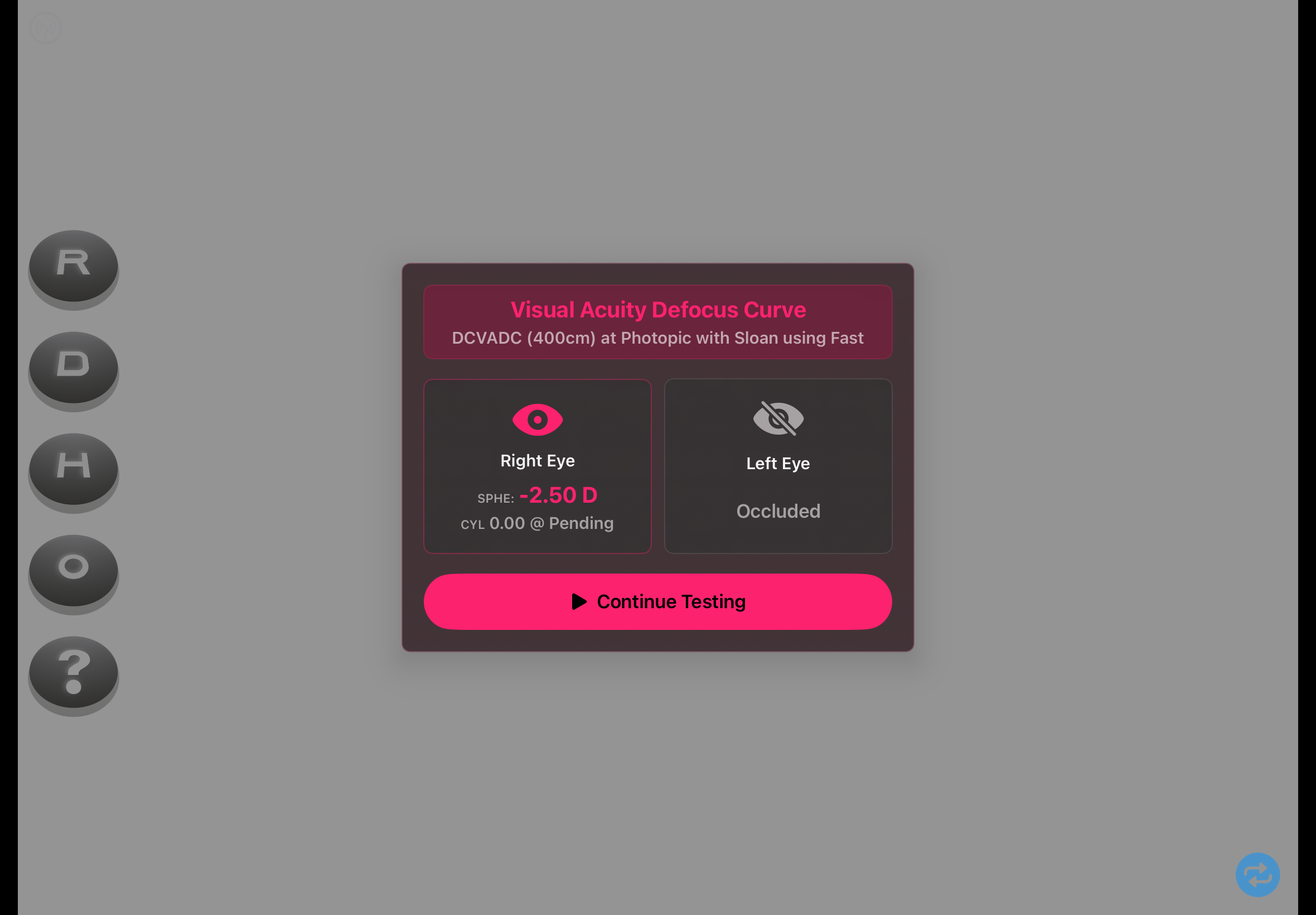
Link every measurement to a participant, eye, IOL, protocol, and visit—from visual acuity to contrast sensitivity and defocus curves.

Private preview · Availability and pricing to be confirmed

ACTUAL APPLICATIONIOLResearch · iPad
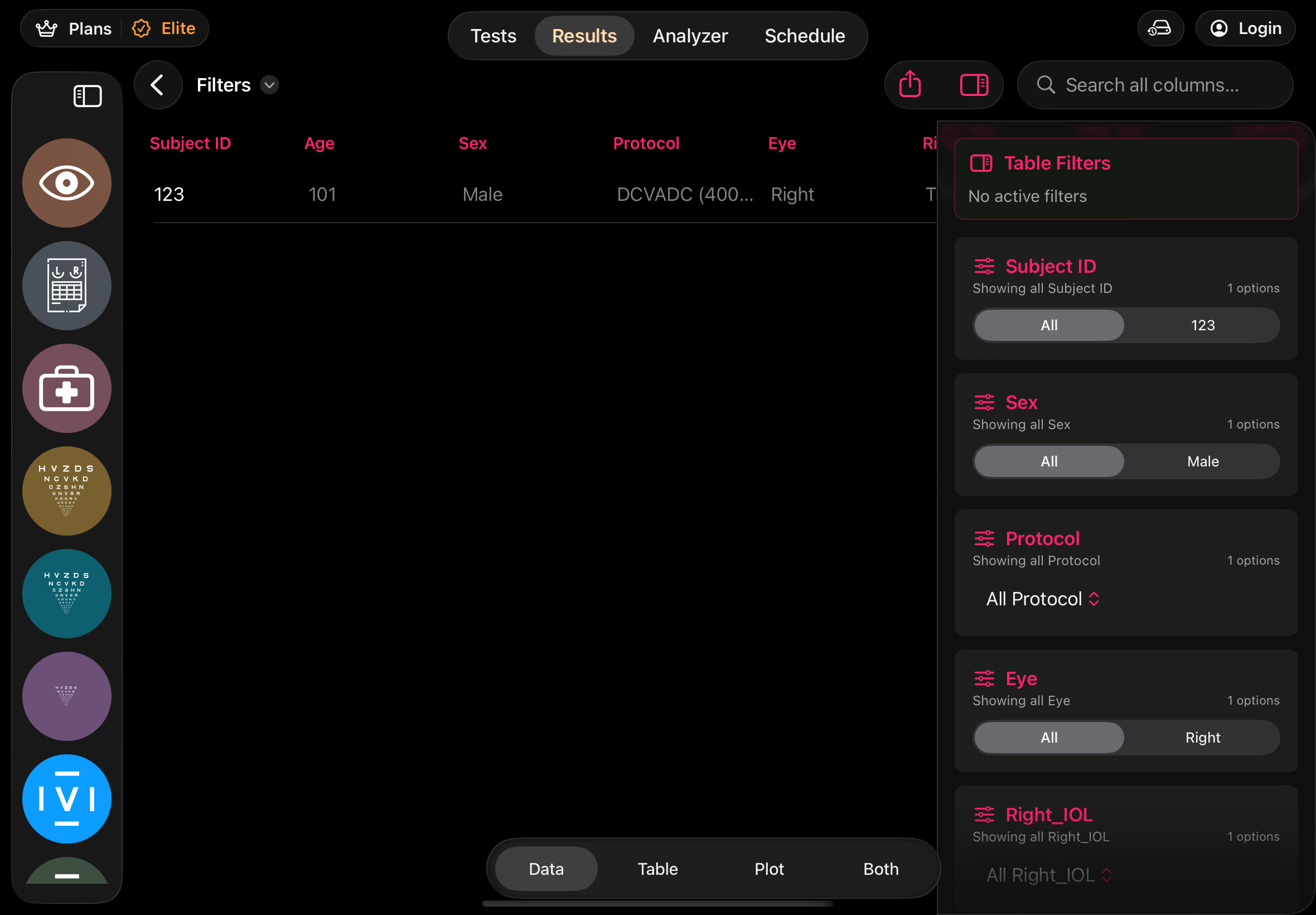
IOLResearch results table with filters for participant, protocol, eye, and implanted lens
Keep the study context beside the results.
Define the protocolCapture measurementsReview outcomes
One research systemProtocol-drivenStandardized captureLongitudinal reviewiPad native

Understand the application

See the complete study workflow on iPad.

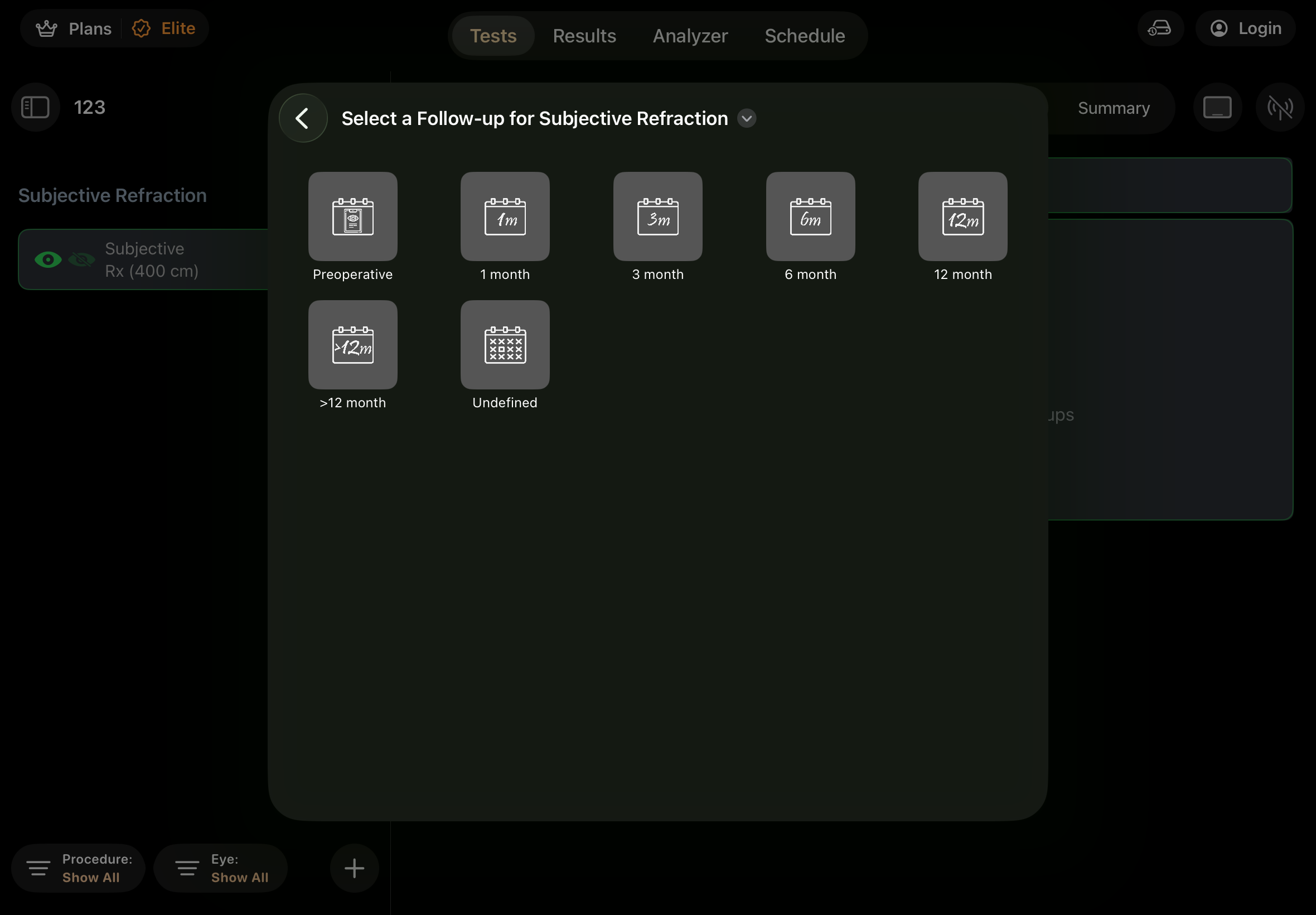
Follow seven stages from study setup to results. Select a stage, then browse its real application screens.

Original application screenshots are shown in English; the explanations follow your selected language.

View the study information structure
  1. 01WorkspaceStudy or center database
  2. 02SubjectPseudonymized record
  3. 03ProcedureMeasurement module
  4. 04ProtocolRepeatable settings
  5. 05VisitResearch timepoint
  6. 06MeasurementGuided data capture
  7. 07ResultsFilters, analysis, export

01 Workspace · Database

Start each research context in its own database.

From my iPad, I can create a dedicated database for a study or center and keep its records separate from unrelated work.

  • Create or open the relevant database
  • Store supporting CSV files beside the workspace
  • Keep study populations clearly separated
Real application screen
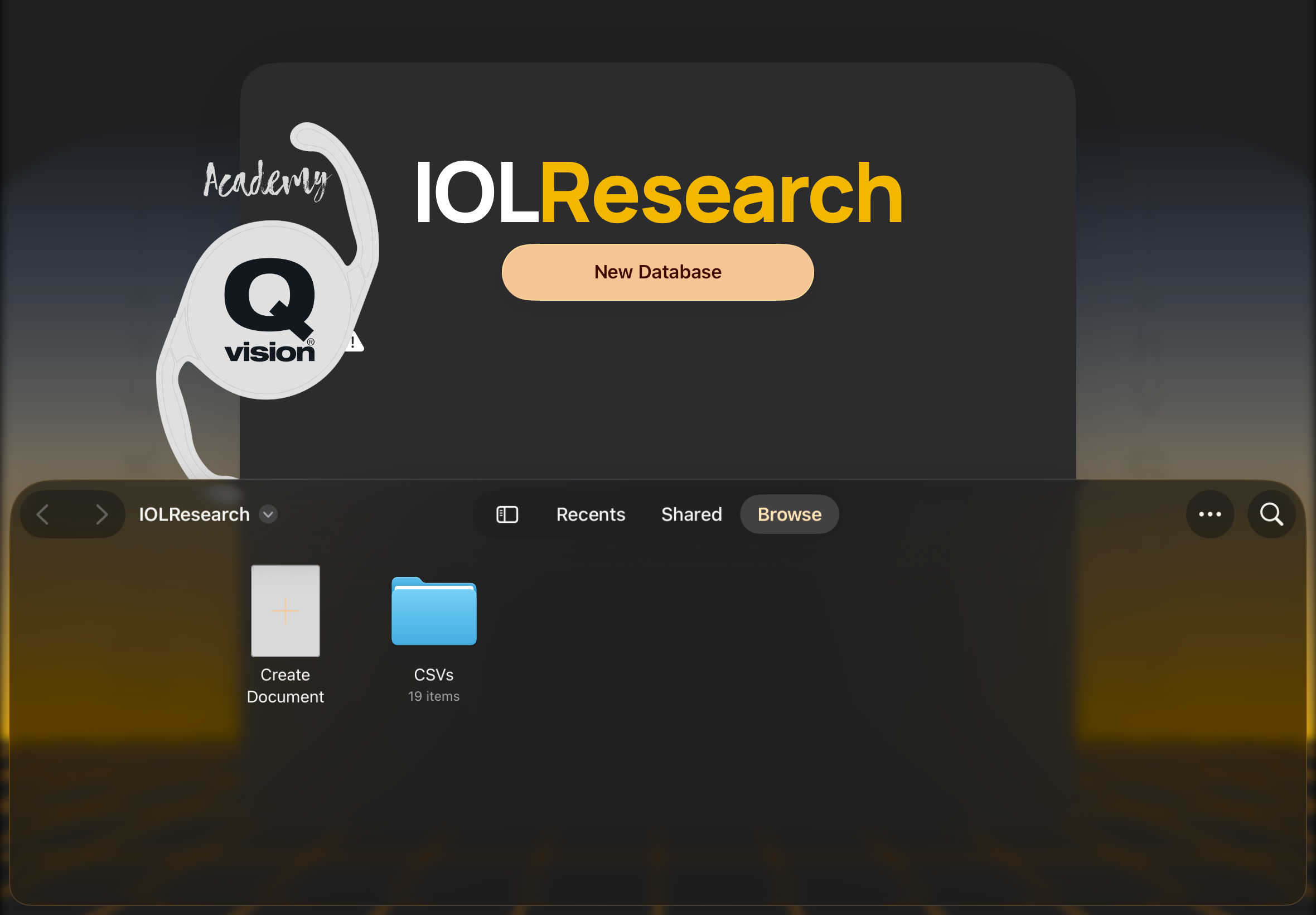
IOLResearch New Database screen with the iPad document browser
New database · Establishing the study workspace

Scientific foundation

Scientific foundation, with a defined scope

IOLResearch is a new integrated application, but its measurement framework extends more than a decade of work with ClinicCSF, Multifocal Lens Analyzer, StereoTAB, and VisionC, together with the Refractive Analysis Toolbox for standardized outcomes analysis.

10+ years

Established research lineage

Predecessor applications have supported clinical and vision-science research for more than a decade.

4 domains

Visual-performance methods

The lineage covers contrast sensitivity, defocus curves, stereopsis, and multi-distance visual acuity.

Published

Method evaluation

Underlying methods have been examined through validation, agreement, reliability, and reproducibility studies.
Peer reviewed

Research application

Predecessor tools have been used in studies of IOLs, refractive surgery, contact lenses, and binocular vision.
Evidence scope

The cited publications support the scientific lineage of the underlying methods and predecessor applications. They do not constitute blanket validation of every current IOLResearch feature or replace protocol-specific calibration, validation, and investigator interpretation.

Subscriptions

Choose the access level that fits your research.

Compare the procedures, study capacity, and workflow tools included with Free, Lite, Pro, and Elite.

Compare every plan feature

Free

Explore the basics

For occasional testing with a small study workspace.

  • 15 subjects · 5 procedure types
  • 1 protocol per procedure
  • Analysis and export not included

Lite

Analyze a small study

For a focused dataset that needs analysis and export.

  • 30 subjects · 8 procedure types
  • 3 protocols per procedure
  • Data and chart export included

Pro

Support ongoing research

For larger studies and an operator-controlled testing setup.

  • Unlimited subjects · 10 procedure types
  • Unlimited protocols per procedure
  • Remote control included

Elite

Use the full procedure library

For studies requiring the broadest set of measurements.

  • Unlimited subjects · 17 procedure types
  • Unlimited scheduling and luminance conditions
  • Analysis, export, and remote control

Start with the procedures and study capacity you need. Pricing, renewal terms, and release availability must be confirmed before choosing a subscription.

Ask about research accessOpens your email application.

Compare plan limits side by side
Compact comparison of IOLResearch subscription plans
CapabilityFreeOccasional userLiteAnalyze a small studyProSupport ongoing researchEliteUse the full procedure library
Procedures
Subjects1530UnlimitedUnlimited
Protocols per procedure13UnlimitedUnlimited
Scheduling××2Unlimited
Analysis×✓✓✓
Remote control××✓✓
Renewal optionsFree accessDescribed in the appDescribed in the appDescribed in the app

Swipe or scroll horizontally to compare all plans. The full comparison includes export and luminance conditions.

Built for protocol flexibility

Build bilateral research scenarios, eye by eye.

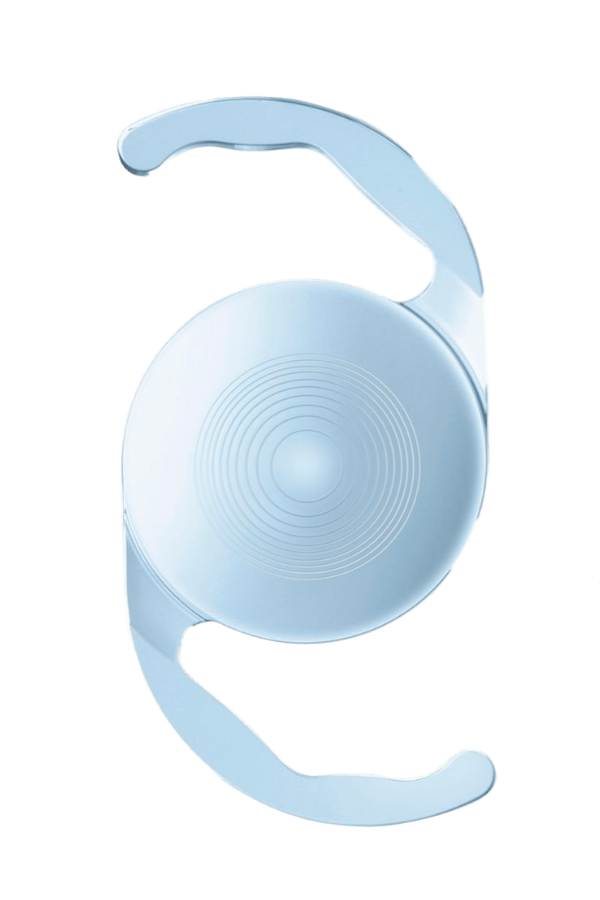
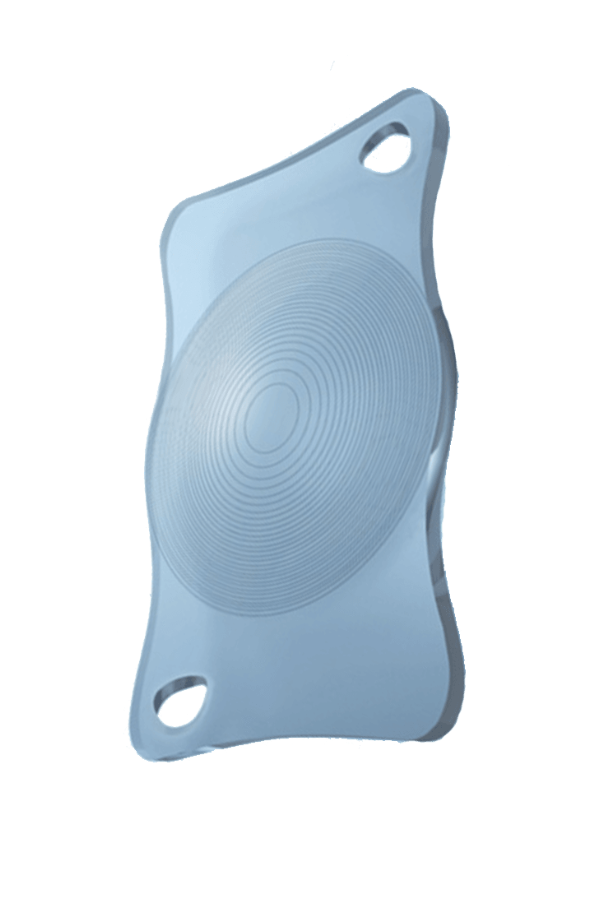
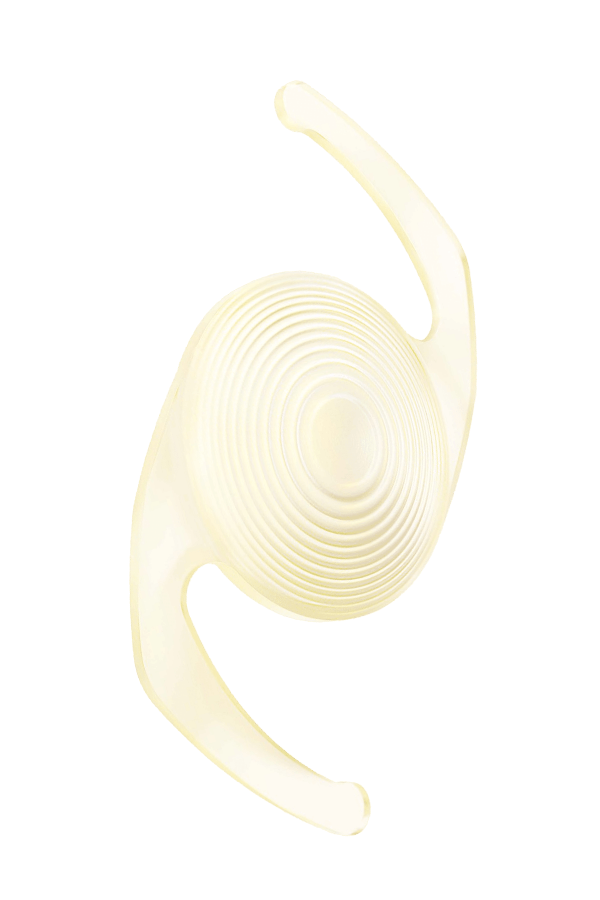
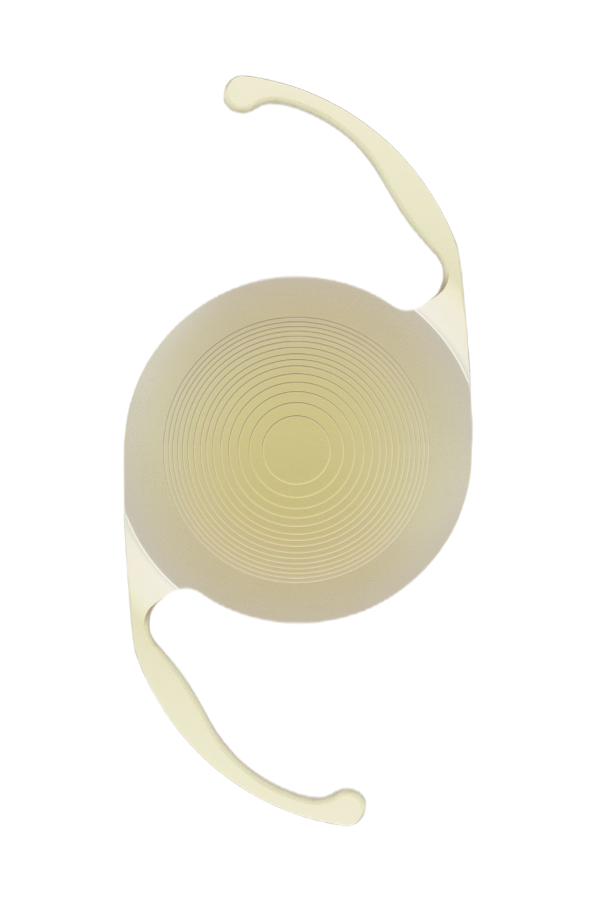
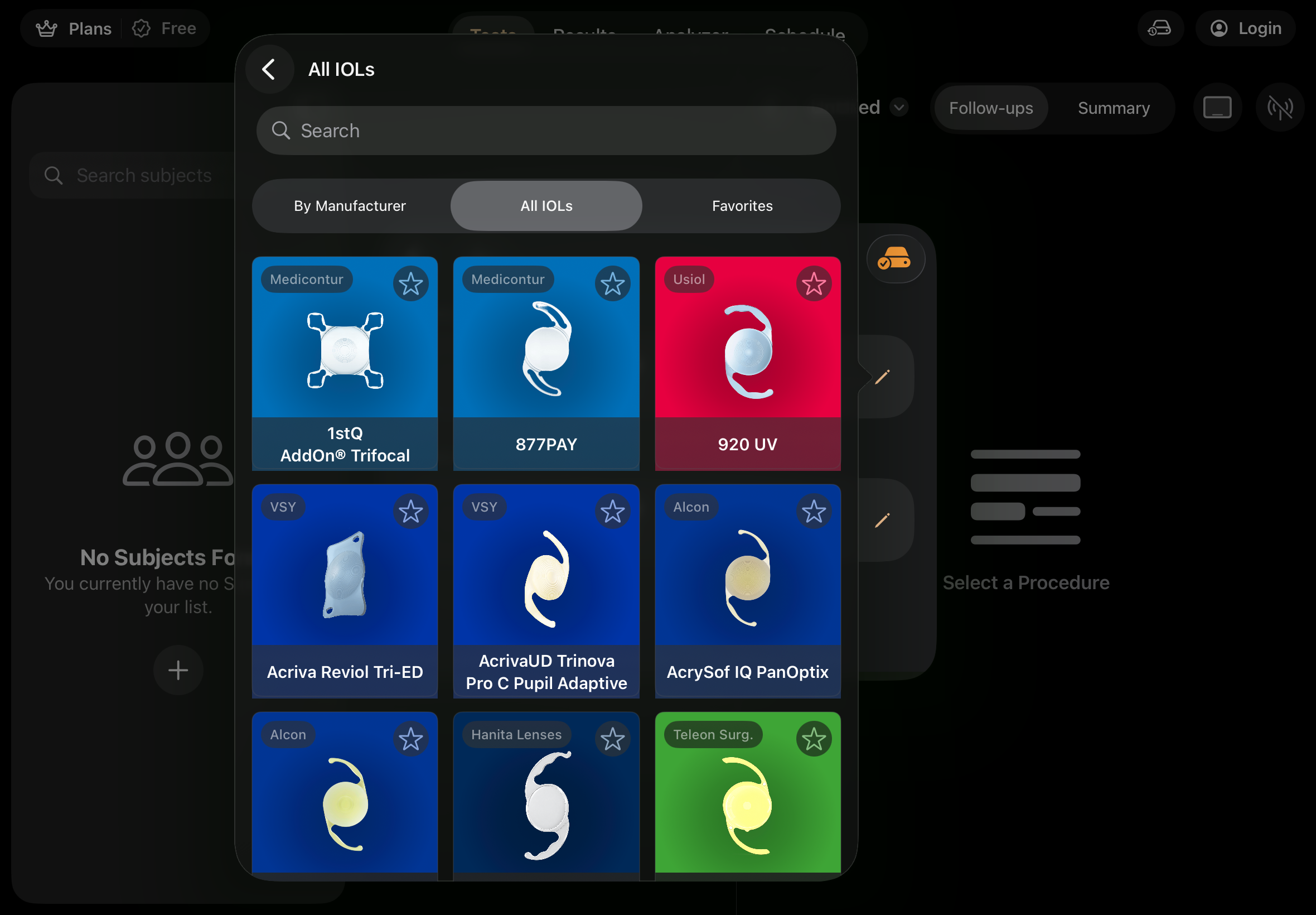
Select from a catalog of more than 120 IOL options from more than 40 manufacturers, assign a lens to the right and left eye, and structure the bilateral solution your protocol is designed to explore.

120+

IOL options

40+

Manufacturers

OD + OS

Independent eye assignment

Assign the IOL for each eye

Protocol configuration
ODRight eye
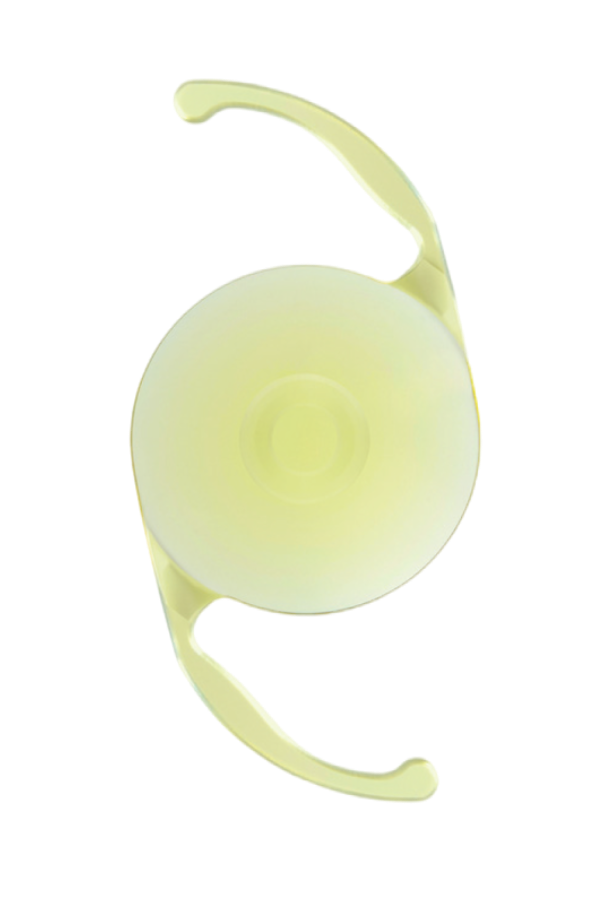
Representative AcrySof IQ Vivity intraocular lens

AcrySof IQ Vivity

Representative selection

Alcon logo
OSLeft eye
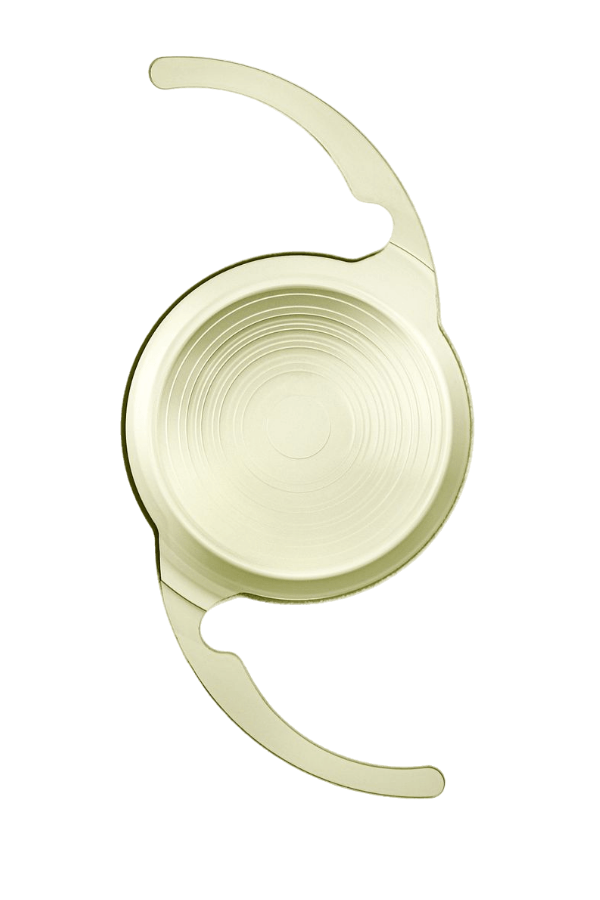
Representative Tecnis Odyssey intraocular lens

Tecnis Odyssey

Representative selection

Johnson & Johnson logo

Explore the catalog

Models 1–6 of 124

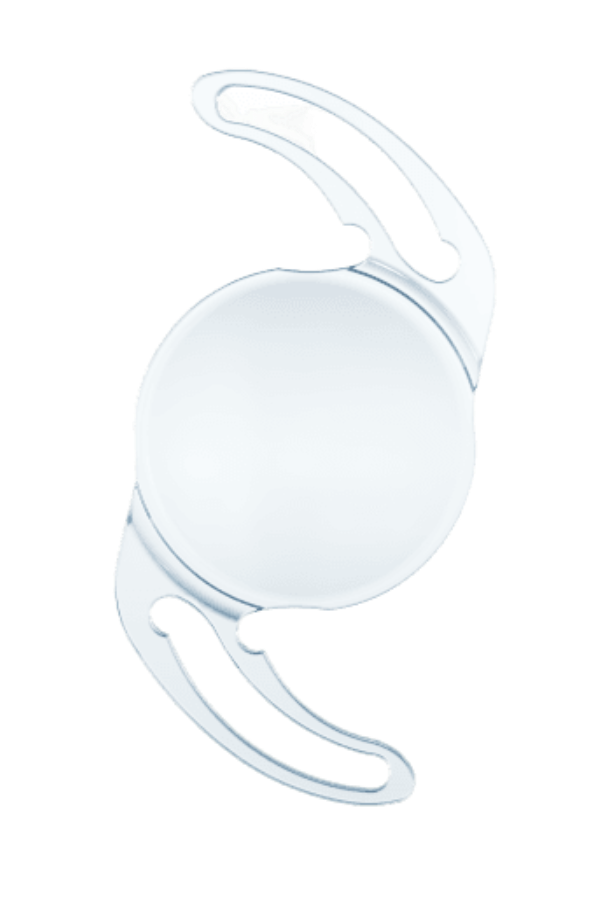
1stQ AddOn Trifocal intraocular lens

1stQ AddOn Trifocal

877PAY intraocular lens

877PAY

920 UV intraocular lens

920 UV

Acriva Reviol Tri ED intraocular lens

Acriva Reviol Tri ED

AcrivaUD Trinova Pro C Pupil Adaptive intraocular lens

AcrivaUD Trinova Pro C Pupil Adaptive

AcrySof IQ PanOptix intraocular lens

AcrySof IQ PanOptix

OU

Binocular

Study both eyes as one visual system.

Assign the protocol’s intended bilateral lens configuration and evaluate outcomes produced by the combined right- and left-eye strategy.

≠

Mix & match

Explore complementary IOL combinations.

Record different IOL models for each eye and investigate the functional-vision profile associated with the planned combination.

D/N

Monovision

Document distance and near eye targets.

Define the intended role of each eye and compare outcomes across the protocol’s distance-dominant and near-support configuration.

These configurations organize research observations; they do not recommend an IOL combination or predict an individual patient outcome.

Manufacturer catalog

Search across a broad IOL ecosystem.

Review all 41 manufacturer logos. Catalog coverage may vary by application version and research program.

Manufacturer names and logos identify catalog entries only and do not indicate sponsorship or endorsement.

Research procedures

Choose the measures your protocol needs.

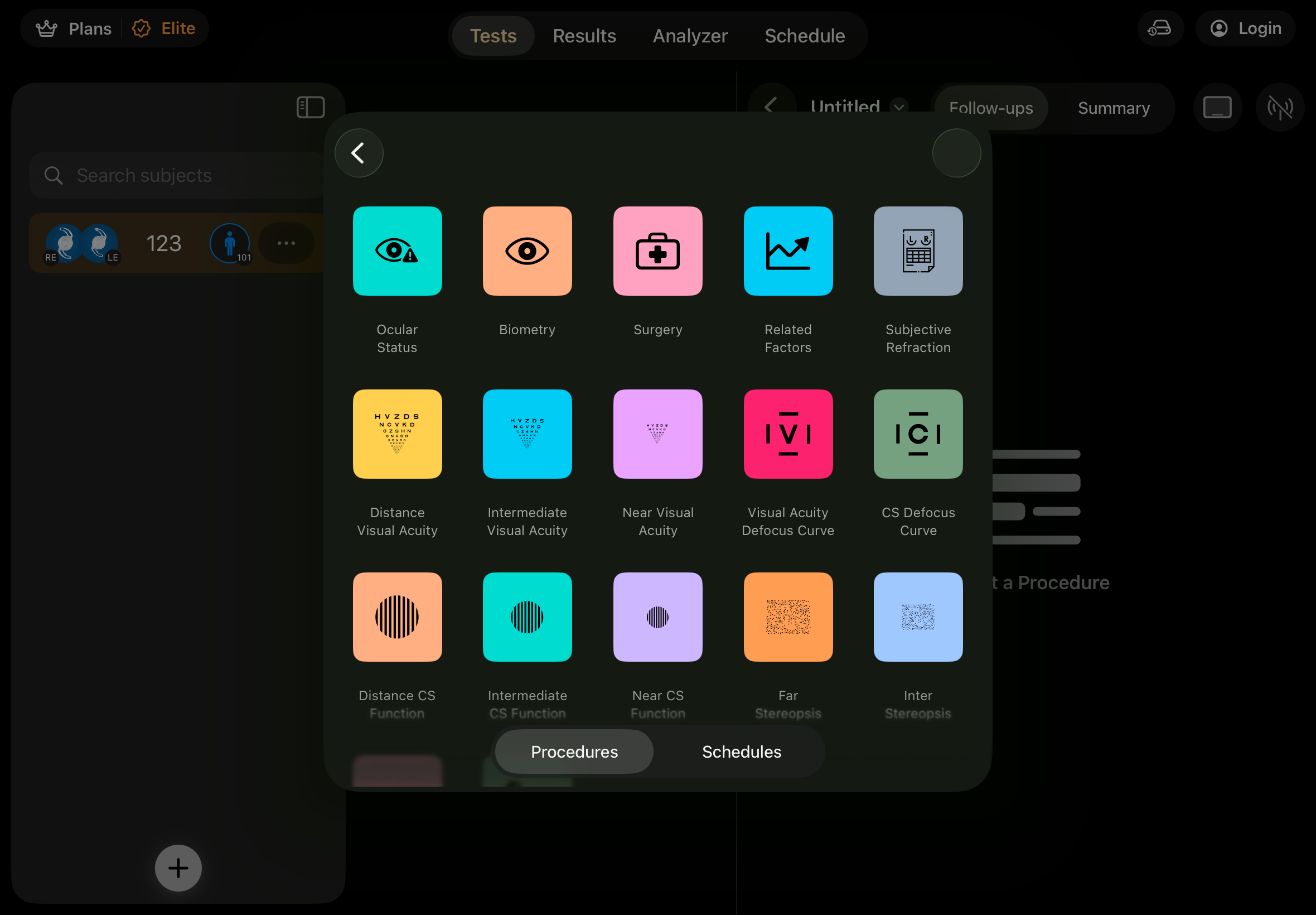
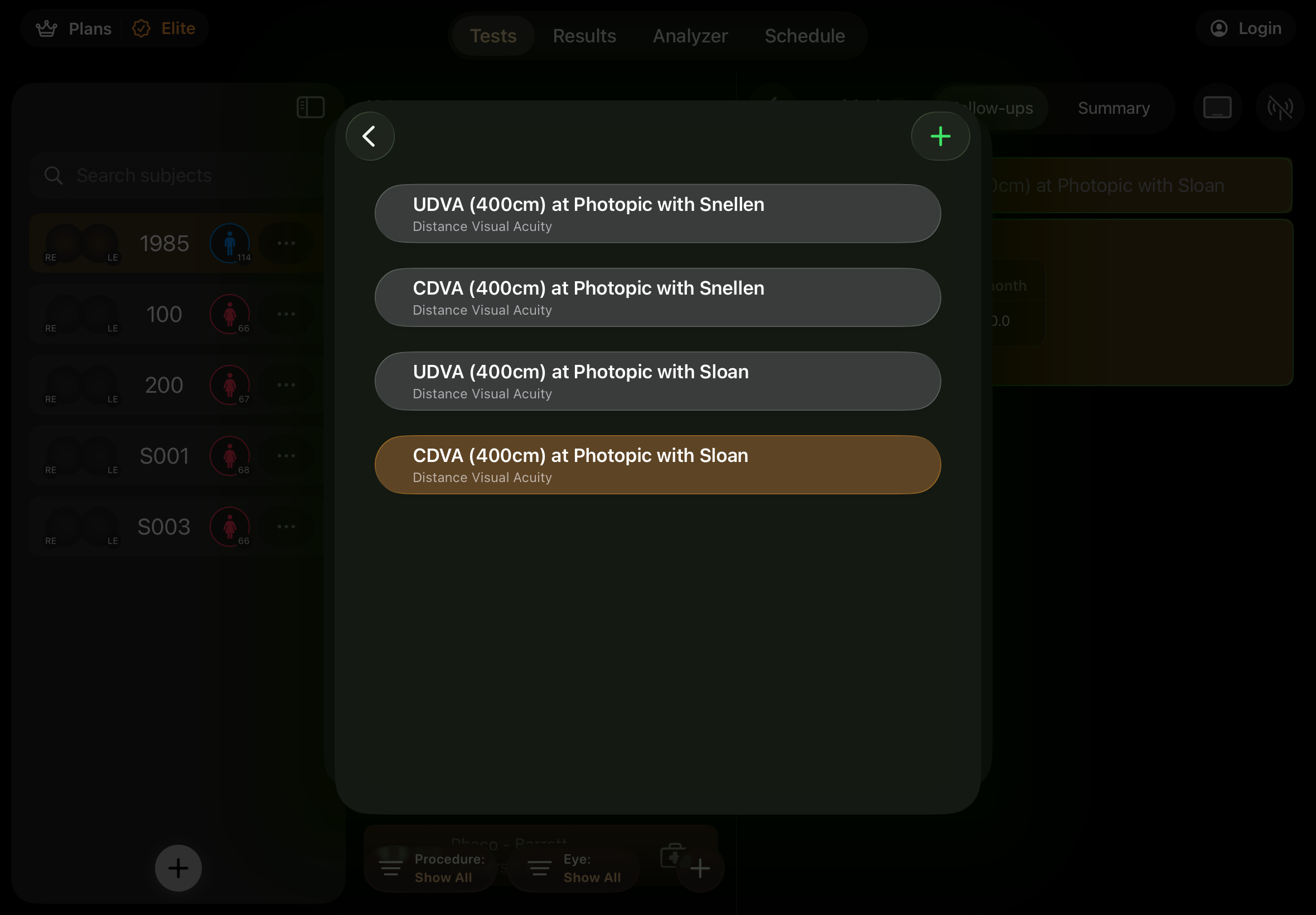
Select a procedure to read its purpose. Available procedures depend on the plan and the study protocol.

Select a procedure

Its measurement purpose will appear here.

Standardized outcomes

Standard Analysis and Plots

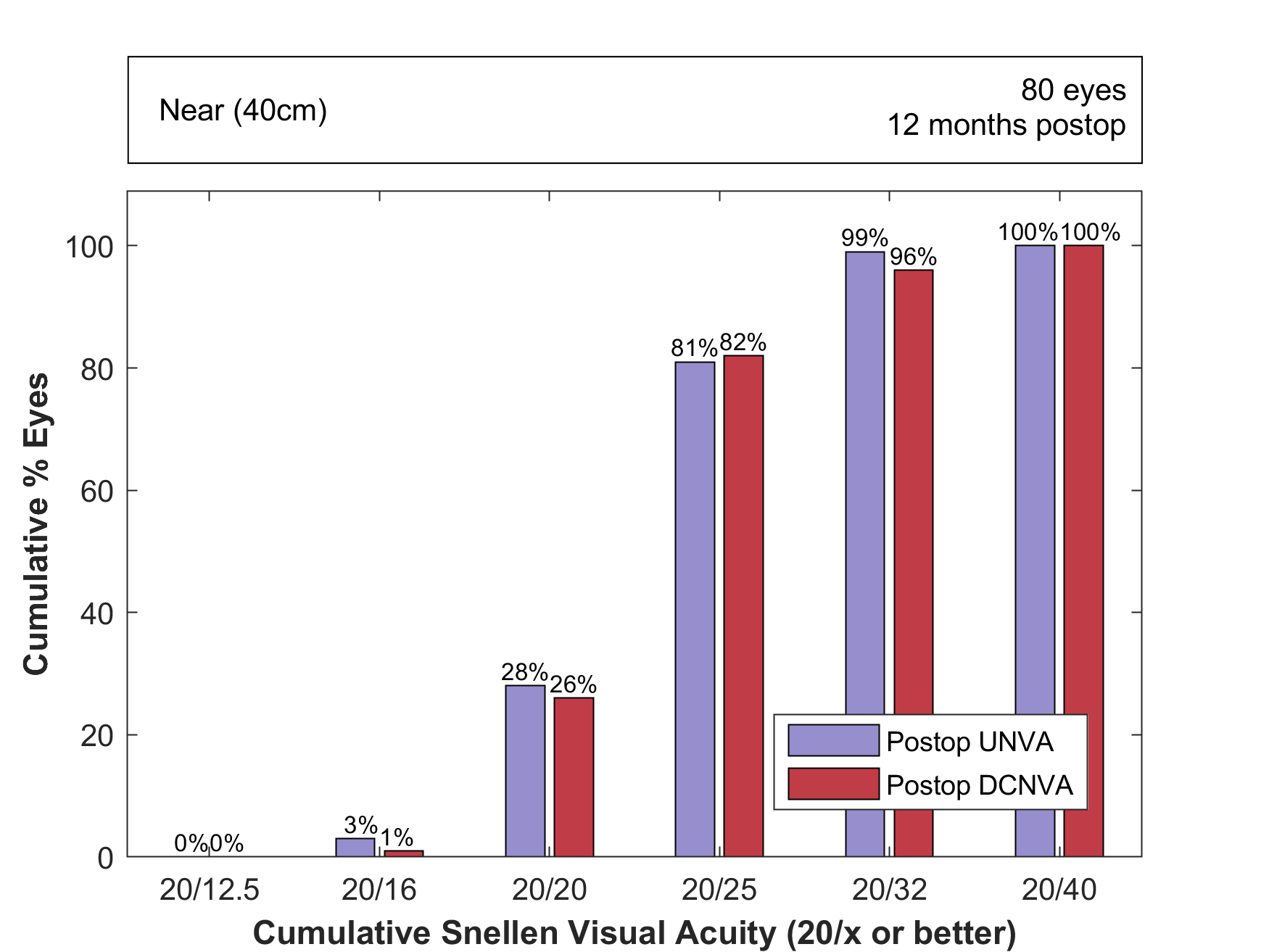
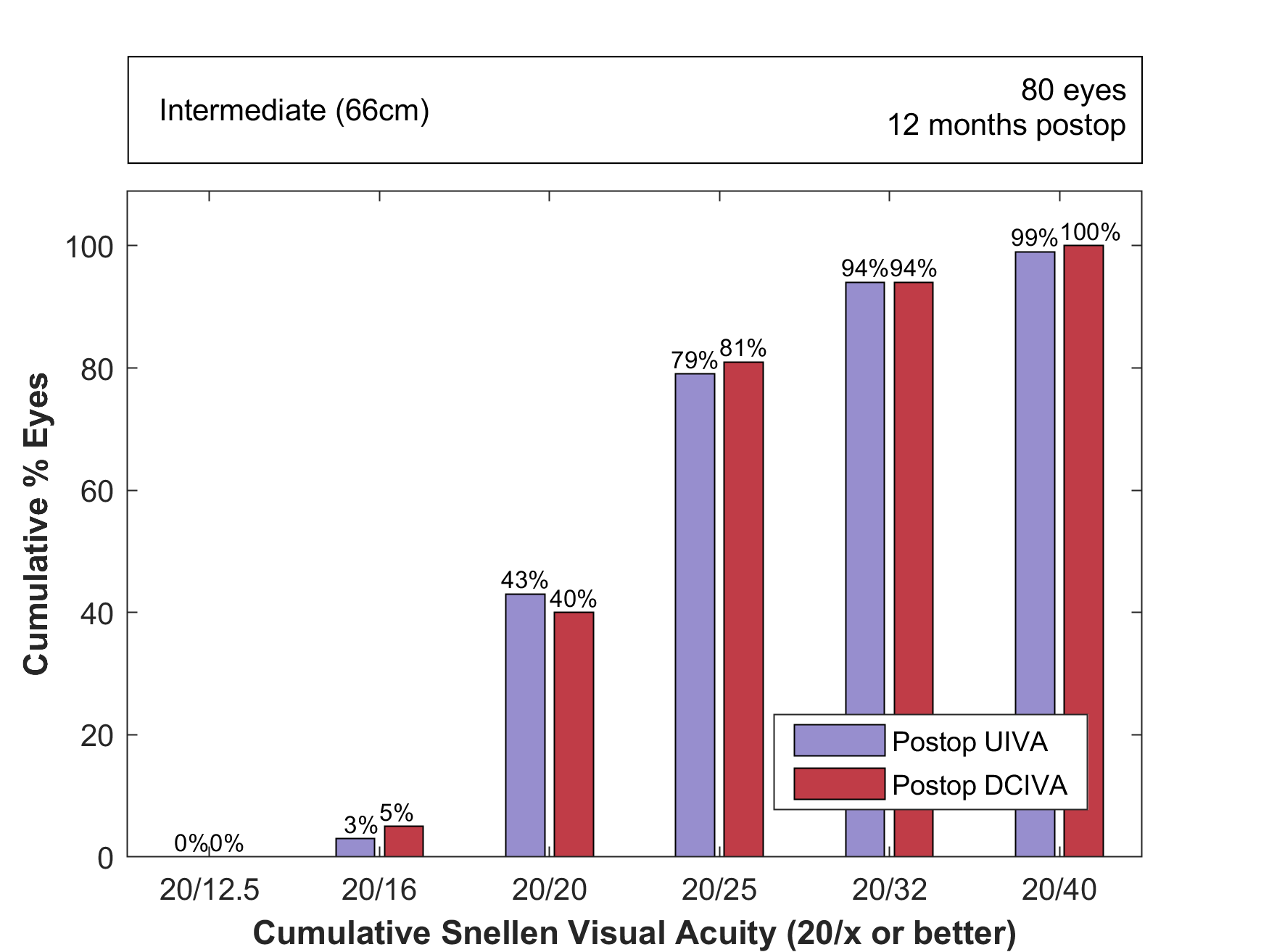
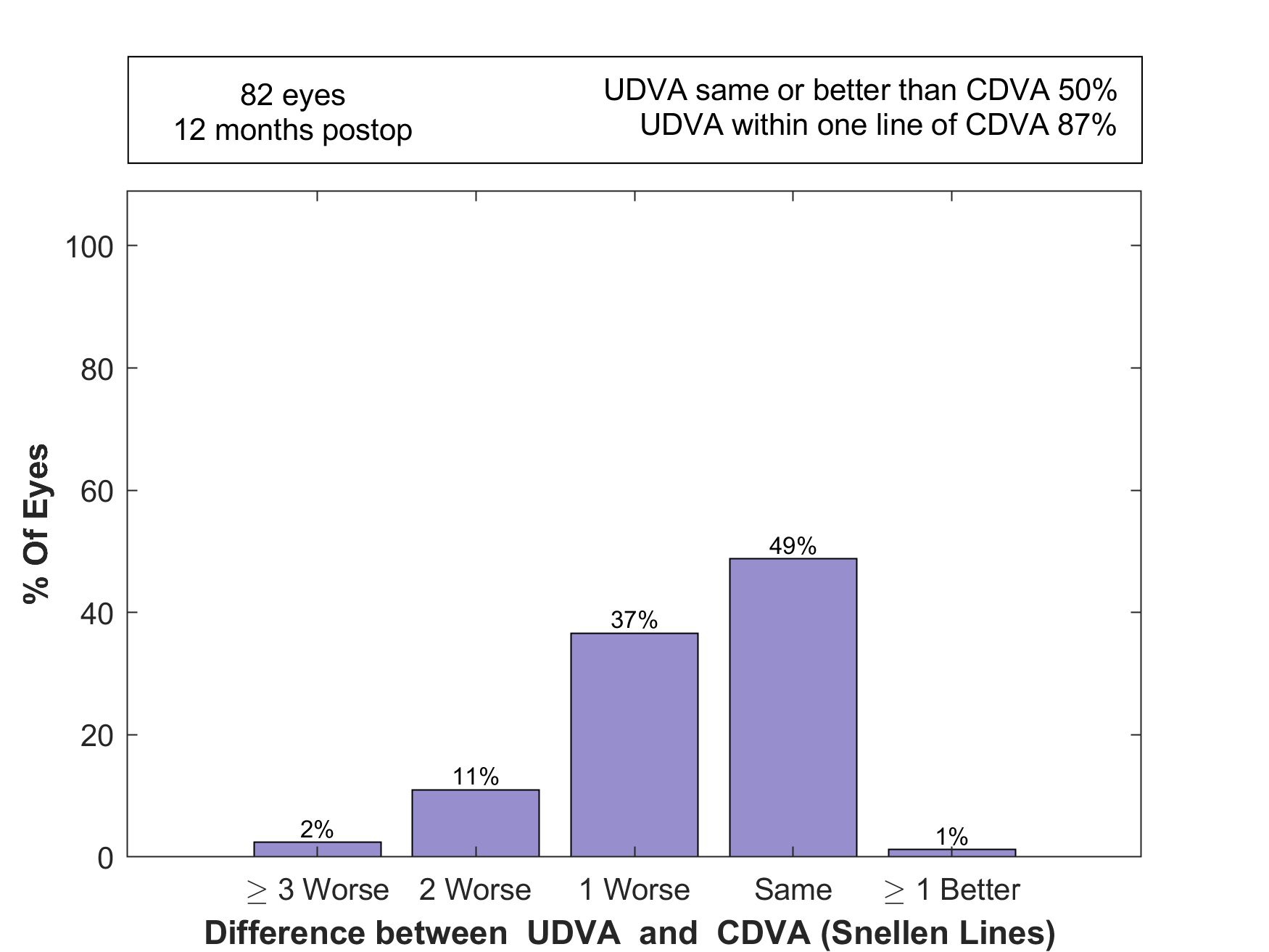
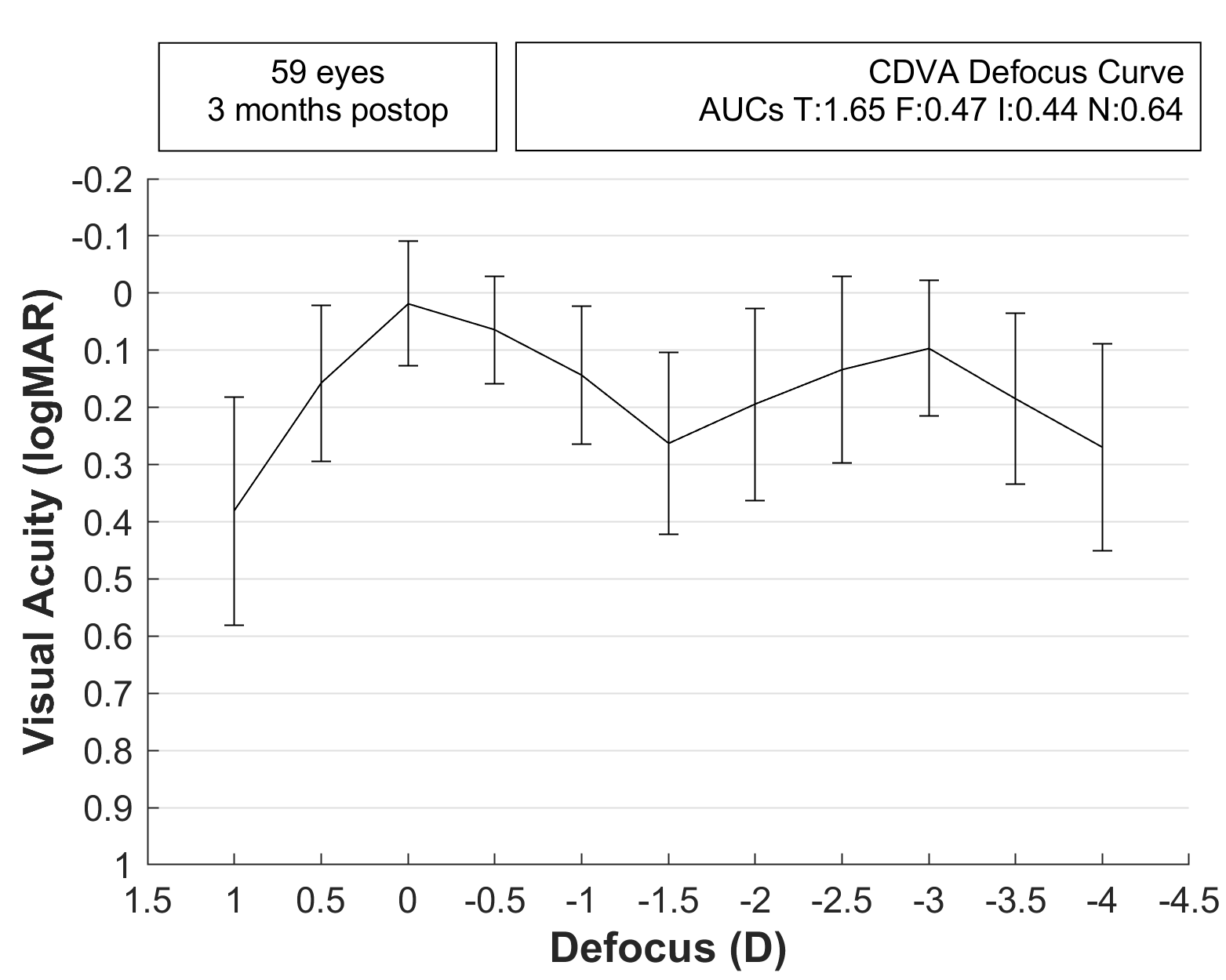
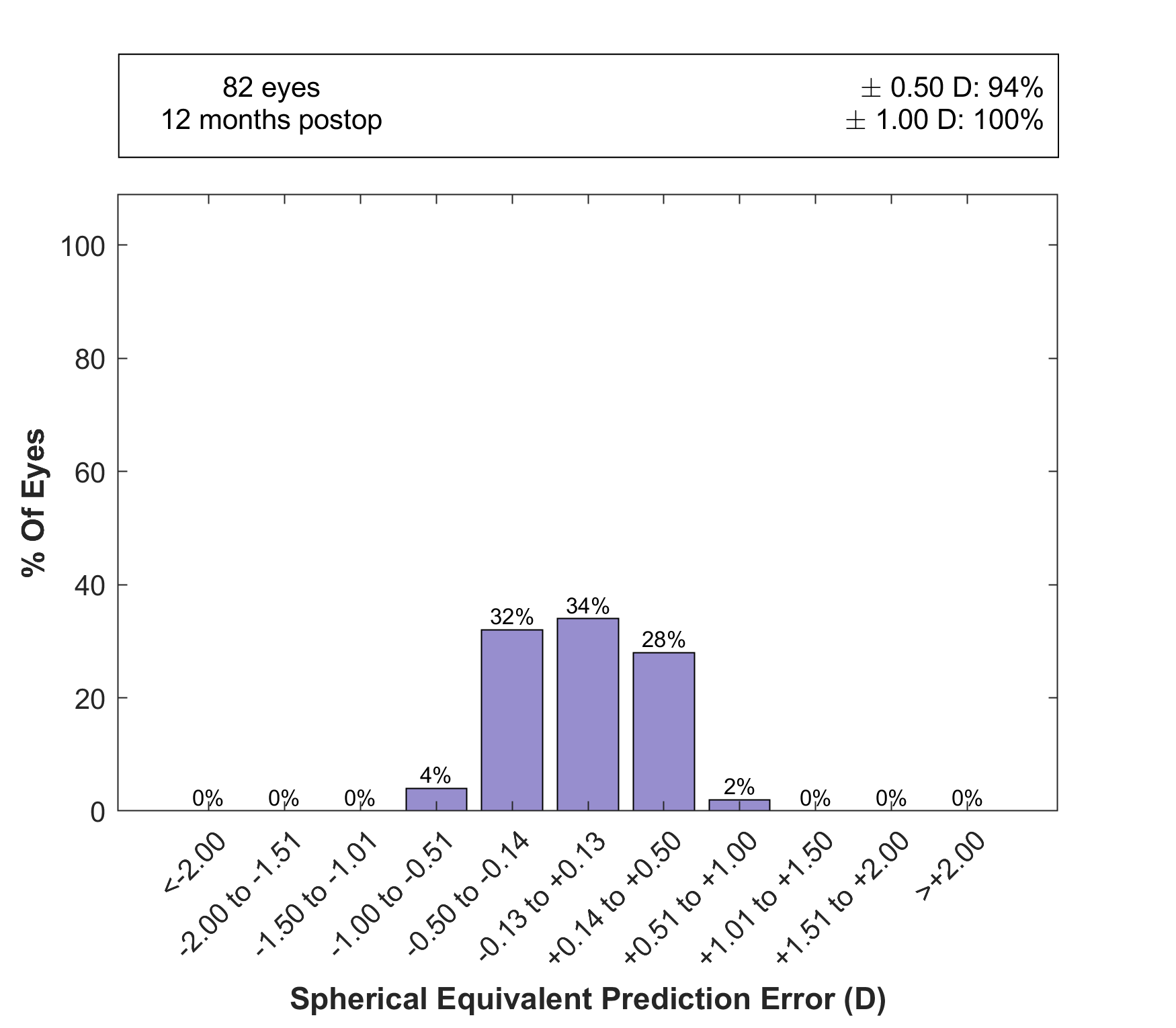
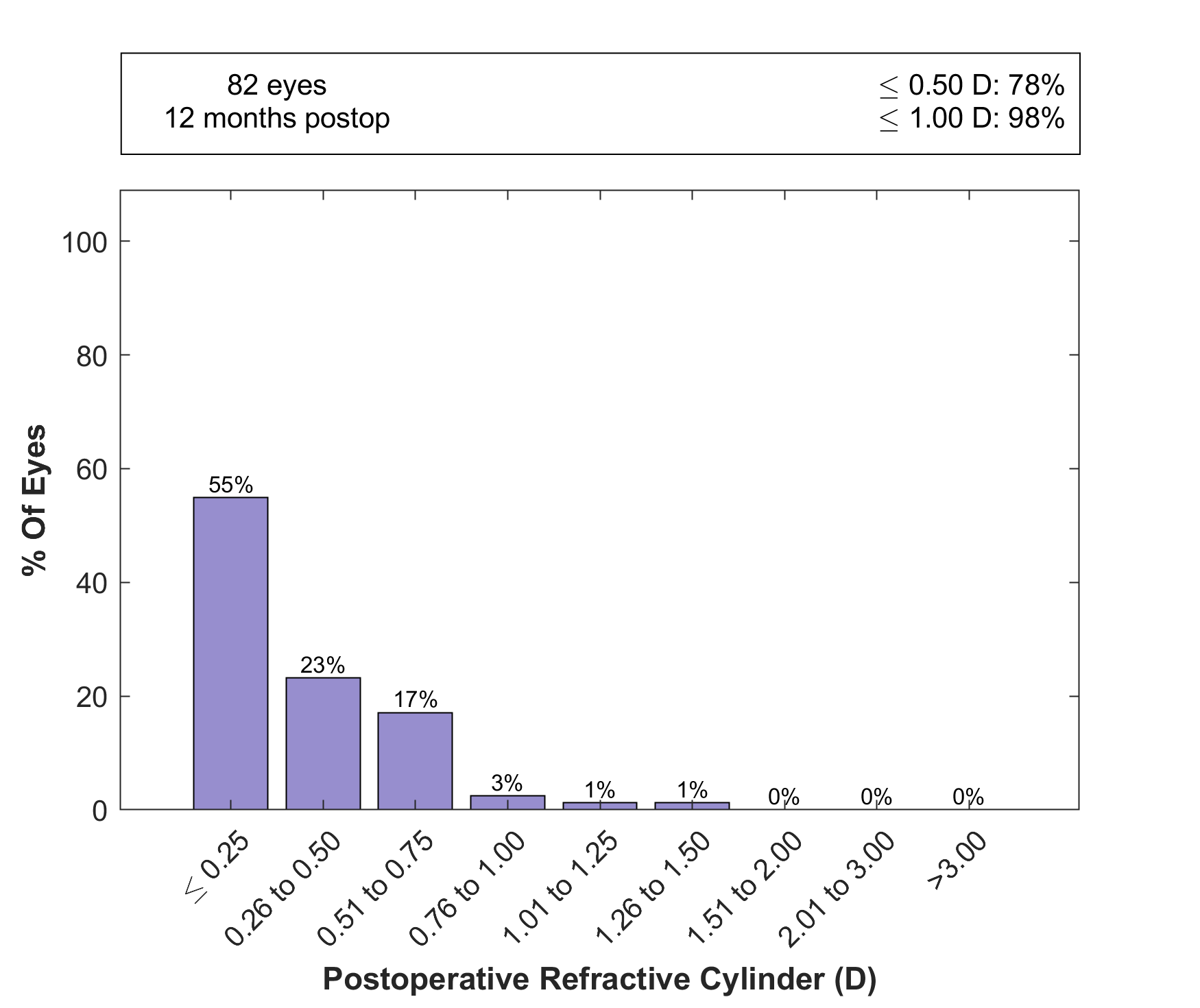
Explore nine standard analysis categories. Each example pairs a figure with its meaning, clinical interpretation, and reporting considerations. Comparisons require consistent testing conditions and clearly defined cohorts.

Scientific abbreviations and units
UDVA / CDVA
Uncorrected / corrected distance visual acuity.
UIVA / DCIVA
Uncorrected / distance-corrected intermediate visual acuity.
UNVA / DCNVA
Uncorrected / distance-corrected near visual acuity.
logMAR / logCS
Logarithm of the minimum angle of resolution / logarithm of contrast sensitivity. Lower logMAR means better acuity; higher logCS means greater contrast sensitivity.
SD / CI / AUC
Standard deviation / confidence interval / area under the curve. State the interval level and AUC calculation method when reporting results.

Inside the Analysis section

Move from collected data to a shared visual language.

Keep the cohort and protocol context visible, review outcomes using established conventions, and produce plots whose meaning is clear beyond a single study.

01 FilterCohort, visit, eye
02 AnalyzeOutcome and summary
03 CompareTable, plot, export

Choose one of nine plots. Use the arrow keys to move between tabs.

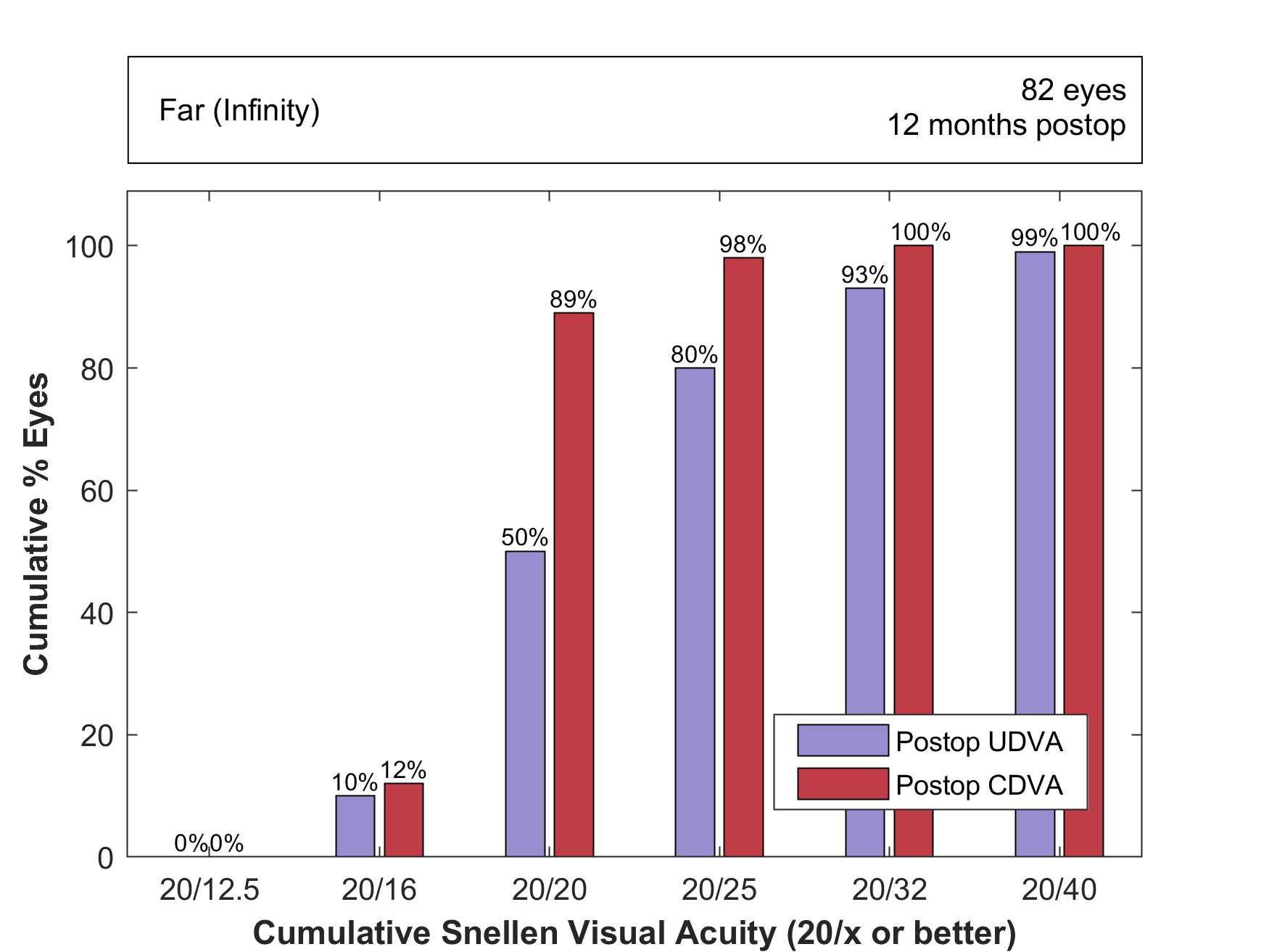
Standard output 01 · Far Distance EfficacyFigure A · Cumulative visual acuities
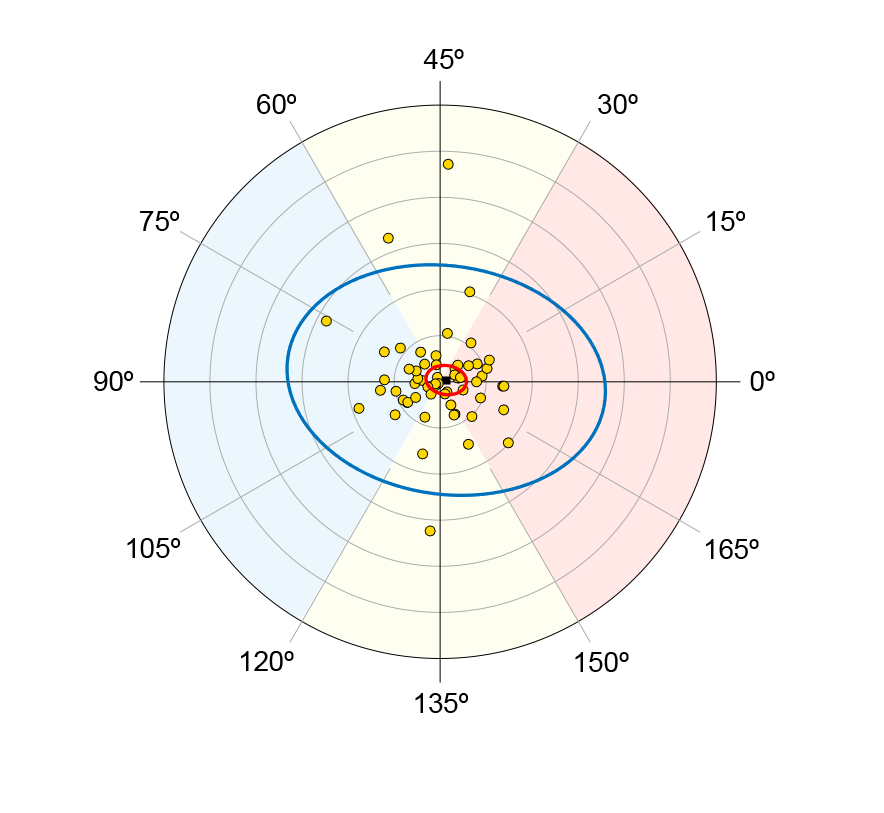
Figure A, cumulative postoperative uncorrected and corrected distance visual acuity at far
Cumulative UDVA and CDVA at distance show how many eyes achieve each visual-acuity threshold.
Read the interpretation and reporting notes
01 · RepresentsWhat the plot represents

The cumulative percentage of eyes reaching each postoperative far-vision threshold for uncorrected distance visual acuity (UDVA) and corrected distance visual acuity (CDVA).

02 · InterpretHow it is clinically interpreted

More eyes reaching the better acuity thresholds indicates stronger distance performance. A smaller separation between UDVA and CDVA means uncorrected vision approaches the eye's best corrected potential.

03 · ConsiderKey points to consider

State the test distance, chart, luminance, correction, follow-up, and whether results represent eyes or subjects. Use standardized acuity notation and define exclusions or adverse-event outliers.

01 · CONTROL

Define the measurement.

State test distance, luminance, correction, chart or stimulus, and whether observations represent eyes or subjects.

02 · REPORT

Show the uncertainty.

Pair central estimates with SD when showing sample variation or 95% CI when showing confidence in the estimated mean.

03 · COMPARE

Keep outputs interoperable.

Consistent units, labels, ranges, and aggregation make results easier to compare and more usable in systematic reviews and meta-analyses.

Scientific context

Fernández J, Ribeiro FJ, Rodríguez-Vallejo M, et al. “Standard for collecting and reporting outcomes of IOL-based refractive surgery: update for enhanced monofocal, EDOF, and multifocal IOLs.” Journal of Cataract & Refractive Surgery. 2022;48:1235–1241.

IOL outcomes standard

Abulafia A, Koch DD, Holladay JT, Wang L, Hill W. “Rethinking astigmatism analysis for intraocular lens-based surgery: suggested terminology, analysis, and standards for outcome reports.” Journal of Cataract & Refractive Surgery. 2018;44:1169–1174.

Astigmatism analysis standard

Reference figures illustrate reporting conventions, not IOLResearch clinical results. Original figure labels are retained in English.

Before using study data

Plan the protocol. Check the data responsibilities.

Participant records

The workflow uses study identifiers. Pseudonymization still requires your team to manage access, any identification key, and the study’s data-handling requirements.

Device and measurement setup

Confirm supported iPad hardware, display preparation, test distances, and the validation needed for your specific protocol before collecting research measurements.

Evidence-centered leadership

From Key Opinion Leader to Key Evidence Leader.

A Key Evidence Leader (KEL) is a clinician or researcher whose influence is grounded in the critical evaluation, generation, and application of clinical evidence. The emphasis moves from personal authority toward transparent, reproducible, and patient-relevant knowledge.

Traditional model

KOL

Key Opinion Leader

Influence is commonly associated with reputation, seniority, professional experience, and the ability to shape peer opinion or practice.

  • 01Experience- and reputation-led influence
  • 02Interprets and communicates knowledge to peers
  • 03May or may not participate directly in research

Evidence-led model

KEL

Key Evidence Leader

Influence is earned through research expertise, analytical rigor, transparent communication, and the ability to translate evidence into clinically meaningful questions and practice.

  • 01Data- and research-driven decision making
  • 02Active involvement in generating and appraising evidence
  • 03Commitment to transparency, integrity, and collaboration

This distinction is summarized from Fernández J. et al., The conceptualization of ‘Key Evidence Leaders’ from ‘Opinion Leaders’: A review also applicable in ophthalmology.

Read the manuscript

Research sponsors

Supporting KEL-led research.

Sponsors are industry organizations supporting Key Evidence Leaders in their use of IOLResearch and in the development of structured simultaneous-vision research workflows.

Sponsor support does not replace each study team’s responsibility for protocol governance, disclosures, analysis, or interpretation of results.

Questions, answered

Before your study begins.

Who is IOLResearch for?

It is designed for clinical researchers studying functional vision around simultaneous-vision procedures, particularly intraocular lens pathways.

Does it replace standard clinical testing?

No. IOLResearch is intended to support—not replace—professional judgment, validated diagnostic equipment, or your required protocols.

Is the application available now?

IOLResearch is in development. This website is a private preview; it does not enroll participants or sell subscriptions. Contact the person who invited you to discuss access and your study requirements.

What do I need to run it?

The product is being designed as an iPad application. Supported hardware, OS versions, and availability will be confirmed before launch.

Two applications · distinct purposes

From IOLResearch to IOLEvidence

IOLResearch helps research teams generate structured data. IOLEvidence is a separate application that helps clinicians access, compare, and interpret synthesized evidence from IOL studies.

IOLResearch app icon

Data generation

IOLResearch

Collect primary research observations through protocol-driven functional-vision assessments.

  • Standardize procedures and testing conditions across participants and visits.
  • Structure longitudinal observations for analysis within the research program.
  • Support the generation of study datasets that can contribute to new evidence.

Purpose

Generate structured research data

Research pathway

IOLEvidence Qvision Academy app icon

Evidence access

IOLEvidence

Access synthesized outcomes from peer-reviewed IOL studies and explore structured comparisons.

  • Browse confirmatory and optimization reports synthesized from peer-reviewed IOL studies.
  • Compare standardized clinical outcomes and explore relevant confounders across studies.
  • Interpret evidence quality and variability through scores, groupings, and meta-analysis insights.

Purpose

Access and interpret synthesized IOL evidence

01

Collect structured data

02

Analyze and publish

03

Appraise and synthesize

04

Access the evidence

Two distinct applications: this is a conceptual evidence pathway, not an automatic transfer of data between IOLResearch and IOLEvidence. Research findings require appropriate analysis, publication, appraisal, and synthesis.